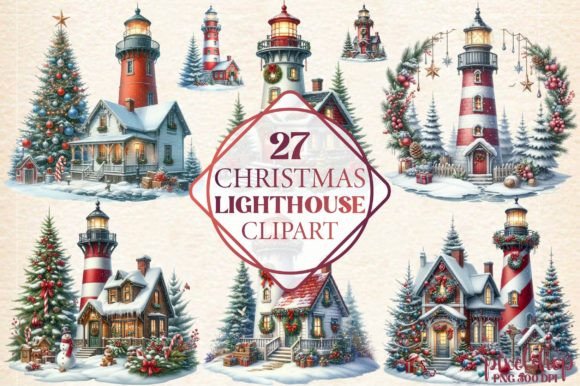
Watercolor Christmas Lighthouse Clipart Review
As a designer who has spent years stitching, testing, and reviewing embroidery files for both personal projects and commercial client work, I approach every new download with a mix of excitement and skepticism. Today, I am looking at the Watercolor Christmas Lighthouse Clipart. At first glance, it sits in the "Freebies" category, which often implies a lower quality threshold, but my experience tells me that even free assets can yield professional results if the underlying design logic holds up. The question is not just about the visual appeal of the clipart itself, but how it translates from a screen to a needle.
The Mood and Visual Personality
When I first opened the file, the immediate impression was one of coastal nostalgia mixed with holiday warmth. Unlike the rigid, geometric lighthouses we often see in traditional Americana designs, this piece embraces a soft, watercolor aesthetic. It feels less like a technical drawing and more like a memory of a winter walk by the sea. The shape is organic, the edges are slightly blurred, and the color palette suggests deep ocean blues, warm reds, and snowy whites. This specific mood makes it an ideal candidate for brands or creators who want to evoke emotion rather than just display a logo.
In the world of digital design assets, this stands out because it avoids the harsh lines that can sometimes look cheap when stitched. However, this artistic choice introduces a specific challenge: translating soft gradients into thread. For a designer evaluating this for real project use, the key is understanding that this design relies on the viewer's eye to fill in the gaps, which works beautifully in embroidery if the stitch density is managed correctly.
Real-World Application: A Custom Tote Bag Scenario
To truly understand the potential of this design, let us imagine a practical scenario. I am preparing a custom embroidered tote bag for a local boutique that sells handmade soaps and holiday gifts. The owner wants something that screams "cozy Christmas" without being cliché. She needs a design that looks good on canvas, holds up to frequent washing, and adds value to a $25 product.
I decided to test the Watercolor Christmas Lighthouse Clipart on a sturdy cotton canvas tote. The first thing I noticed was how the design fits the narrative of the shop. It isn't just a random image; it feels like a story element. When stitched onto the fabric, the soft edges of the lighthouse create a gentle focal point. Customers browsing the booth would likely pause here because the design feels curated rather than mass-produced. It elevates the perceived value of the finished product, making a simple tote feel like a thoughtful, personalized gift.
This same logic applies to other items like aprons, kitchen towels, or baby onesies. The lighthouse theme resonates strongly with families who love the coast or have a connection to maritime history. For a small business owner selling on Etsy, using this design allows them to tap into a niche market that appreciates rustic, handcrafted aesthetics. It transforms a generic holiday item into a boutique-quality product that customers are willing to pay a premium for.
Technical Performance and Stitch Clarity
However, the transition from digital art to machine embroidery requires careful consideration. The watercolor style means there are no hard outlines. In a standard machine embroidery design, outlines help define shapes, especially on textured fabrics. Without them, the design relies entirely on the contrast of the thread colors and the texture of the stitches themselves. If you are working with a satin stitch for the main body of the lighthouse, you must ensure the direction of the stitches follows the flow of the watercolor wash to maintain the illusion of depth.
For a fill stitch area, the density becomes critical. Too dense, and the fabric puckers, destroying the delicate look of the watercolor effect. Too loose, and the background fabric shows through, making the image muddy. I recommend testing the design on scrap fabric first to dial in the perfect tension. Additionally, the lack of defined borders means that stitch density variations can be subtle. On a dark fabric, the lighter threads might get lost if the underlay isn't robust enough, while on a light fabric, the darker accents need to pop without bleeding into the surrounding white space.
There are also specific areas where this design should be used with caution. If you plan to put this on a curved surface like a cap or a hat, the distortion of the watercolor edges can become problematic. The soft lines may warp in ways that make the lighthouse look unrecognizable. Similarly, on thin or stretchy fabrics, the weight of the stitches required to hold the shape together could cause the material to pucker significantly. In these cases, a stabilizer is non-negotiable, and you might need to adjust the hoop size to ensure the fabric remains taut during the stitching process.
Designing for Commercial Success
For those of you running a craft business or selling custom apparel, the decision to use this design comes down to brand consistency. Does this lighthouse fit your overall aesthetic? If your brand is all about bold, graphic tees, this soft design might clash. But if your brand focuses on handmade goods, nursery decor, or holiday gifts, it is a perfect match. The embroidery project becomes more than just a decoration; it becomes a branding tool that signals quality and attention to detail.
When creating printable mockups for your listings, remember that the final product will never look exactly like the digital file. The texture of the thread adds a dimension that screens cannot replicate. To build customer trust, show photos of the actual finished product alongside the digital preview. This transparency helps manage expectations and reduces returns. Furthermore, ensure that the design is scalable. While the watercolor style works well for medium-sized applications like chest logos or pocket placements, shrinking it down too much for a tiny patch or a button might result in a loss of detail that ruins the effect.
Practical Designer Notes for Implementation
Before you commit to a full production run, there are several steps every experienced maker should take. First, always inspect the small details. In a watercolor style, fine lines can disappear if the thread thickness is too heavy. Second, check the licensing terms carefully. Even though this is listed under Freebies, some creators restrict commercial use. Confirm whether you are allowed to sell finished items made with this embroidery file before you start marketing your products.
Third, test the color contrast. Run a quick stitch-out in black and white to see if the composition still holds together without color cues. This ensures the design has strong form regardless of the thread palette you choose. Fourth, verify the hoop size requirements. If the design is large, you may need to re-hoop multiple times, which increases the risk of misalignment. Finally, consider the end-user. Will they be washing this item frequently? If so, ensure the design is durable and won't snag easily. For items like holiday embroidery pieces that are given as gifts, the presentation matters just as much as the stitching.
The Watercolor Christmas Lighthouse Clipart offers a unique opportunity to blend artistic flair with functional embroidery. It is not a plug-and-play solution for every situation, but for the right project, it delivers a level of sophistication that sets a brand apart. By understanding its strengths and limitations, designers can turn a simple free asset into a cornerstone of their handmade product line.